GMG Upcoming Events
- >> Click here for upcoming event details! <<
- 9/21: Bocce Ball, 2pm, WPLBC
- 9/28: Build Tiny Houses, 9am-2pm
- 10/5: Pickleball/Cornhole, 2pm, LHCC
- 10/6 (Tuesday): Breakfast Group, 9:30am, Pacha Cafe
- 10/6 (Tuesday): Planning Group Meeting, 2pm, GSC
- 10/12: Elderhood: "Joy, Curiosity and Growth", 2pm, GSC
- 10/19: Bocce ball, 2pm, WPLBC
- 10/26: Murder Mystery Game program, 2pm, GSC
- 11/2: Pickleball, 2pm, LHCC
- 11/3 (Tuesday): Breakfast Group, 9:30am, Serendipity Cafe
- 11/9: Piper's Creek Salmon Run, 2pm, Carkeek Park
- 11/16: Bocce Ball, 2pm, WPLBC
- 11/23: Amazing Vitality Secrets from Our 95-Year-Old Neighbor, 2pm, GSC
- 11/30: "Show & Tell", 2pm, GSC
- 12/3 (Thursday): Elderhood - Loss & Grief, 2pm, GSC
- 12/7: Pickleball, 2pm, LHCC
- 12/14: "Senior Olympics", 2pm, GSC
- 12/21: Bocce Ball, 2pm, WPLBC
- 12/28: Special Movie, 2pm, GSC
- Other possible events for 2026-2027
Missed an event? Find out what happened here!
Power Exercises Make Older Men Healthier
Power training -- which emphasizes moving resistance with explosive speed and velocity rather than just lifting heavy weight -- offers unique, critical health advantages, such as better cardiovascular function, blood sugar regulation, sharper brain function and fall prevention. So what's not to like about this?
While standard strength training focuses on force, power training focuses on quickness of force, making it uniquely suited to counteract age-related physical decline.
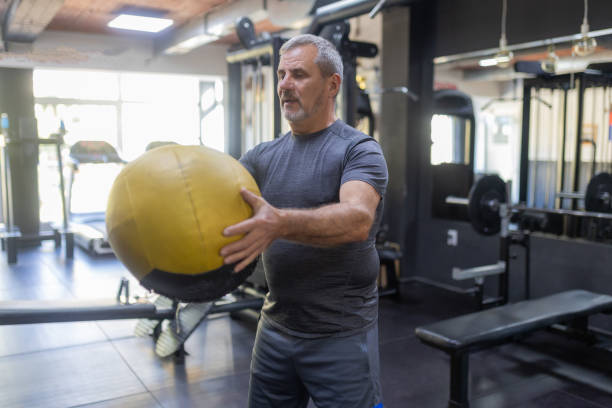 Power training with a medicine ball
For men over 65, traditional strength training remains very beneficial, but adding or emphasizing fast, explosive efforts with light–moderate loads gives extra improvements in power, mobility, balance, and fall‑related function. The core difference is speed of movement: strength focuses on how much you can lift; power training focuses on how fast you can produce force, which appears more closely tied to staying mobile and independent in older age.
Power Training vs. Strength Training
Strength training: Lifting and lowering weights under control at a moderate speed, usually heavier loads.
Power training: Dynamic movements designed to maximize force production in the shortest time possible by combining strength and speed (Power = Force times Velocity). Power training requires maximum explosive intent.
If using weights, you lift the weight as fast as possible in the effort phase, then lowering under control, often with light–moderate loads (≈20–70% of 1‑repetition maximum).
Both types of exercise can use the same gym machines or exercises; the main distinction is movement speed, not equipment.
Health Benefits of Power Training for Older Men
Fall Prevention: Aging causes a rapid loss of fast-twitch muscle fibers, which are responsible for quick reactions. Power exercises specifically target these fibers, giving men the split-second reflexes needed to regain their balance and avoid a fall.
Easier Daily Tasks: Everyday activities require rapid force, such as getting out of a deep chair, stepping off a curb, or catching an object. Power training provides a distinct advantage over standard strength training for maintaining this type of physical autonomy.
Enhanced Joint Health & Mobility: Power routines improve the body's rate of force development and joint flexibility. Strengthening the muscles around key joints like the knees and hips helps stabilize them, which can reduce osteoarthritis pain.
Improved Bone Density: Combining speed with resistance places a dynamic load on the skeletal system. This stimulates bone-building activity more effectively than steady-paced lifting, helping to stave off osteoporosis and fractures.
Cardiovascular Support: Moving weights explosively elevates the heart rate, providing a minor aerobic stimulus alongside muscular benefits. This contributes to lowered blood pressure and decreased heart disease risk.
Blood Sugar Regulation: High-velocity muscle contractions draw on stored glucose. This improves insulin sensitivity, helping men over 65 manage or prevent Type 2 diabetes.
Sharper Brain Function: Coordinating quick movements requires a strong connection between the nervous system and muscles. This complex neuromuscular engagement protects cognitive health and delays memory decline.
Muscle power and speed: Power training produces larger gains in muscle power than strength training, while strength gains are similar.
Beginning Power Exercises per the American College of Sports Medicine
The American College of Sports Medicine suggests several exercises for older individuals. They say: "As we age, we naturally lose muscle mass and strength, especially after age 50. Strength and power exercises can help you stay active, improve balance, support everyday activities, and lower the risk of falls. Power exercises focus on moving with speed and control to help maintain mobility and physical function.
The following exercises can be added to your workout routine based on your fitness level and abilities. Working with a certified exercise professional can help you choose safe and effective options for your needs."
Jump Training
Jump training can be a safe and helpful exercise for older adults when started slowly and progressed over time. Simple hopping and jumping exercises can improve strength, balance, power, and everyday movement. They also help work fast-moving muscles that support mobility and may lower the risk of falls. Exercises using one or both legs can strengthen the thighs, hips, glutes, hamstrings, and calves.
- Frequency: 1–3 sessions per week
- Intensity: 3–10 jumps per set, two or more sets per exercise, one or more exercises per session
- Time: 60–120 seconds between sets
- Type: bodyweight for single and double leg
Although there are a number of possible jump exercises, they describe two types of hopping exercises to get started.
Forward and Backward Hops
- Begin with only forward hops, and progress to hoping both forward and backward
- Jump as quickly and high as possible
- Land softly with knees and ankles bent
- Can be progressed to single-leg
Side to Side (Lateral) Hops
- Progress to lateral hops after mastering forward and backward hops
- Jump as quickly and high as possible
- Land softly with knees and ankles bent
- Can be progressed to single-leg
Medicine Ball Exercises
Many strength exercises in the gym involve moving forward and backward, but daily activities require movement in many directions. Medicine ball throws are a fun way to build strength, power, and coordination while training the body to move more naturally. These exercises can strengthen the core, back, arms, and legs while improving movement speed and balance.
Start with a light medicine ball and focus on controlled, quick movements. As you become more comfortable and stronger, you can slowly increase the weight. If standing feels unsteady, begin seated on a chair or bench before progressing to standing exercises.
- Frequency: 1–2 sessions per week
- Intensity: 5–10 throws/slams per set, two or more sets per exercise, one or more exercises per session
- Time: 3–5 seconds between repetitions, 60–120 seconds between sets
- Type: progressively loaded medicine balls based on movement velocity
Medicine Ball Slam
Raise the medicine ball above your head to a fully standing position before throwing the ball downward explosively with the arms and simultaneously bending your knees.
Medicine Ball Rotational Throw
First stand with the medicine ball with both hands approximately 4 feet from a wall. Then rotate the medicine ball toward your back hip and then transfer your weight from the back hip to the front hip while rotating your hips and torso to throw the ball explosively against the wall.
Medicine Ball Chest Pass
Stand in a semi-squat position while holding the medicine ball with both hands approximately 4 feet from a wall. Then extend your arms to throw the ball explosively against the wall while maintaining an upright position.
Other Examples of
Power Exercises
If you're not physically fit, we recommend you consult with a qualified and experienced personal trainer before undertaking any of the exercises listed below.
Kettlebell Swing
This is a lower body hinge. Stand over a kettlebell with a wide stance. Hinge at your hips, push your glutes back, and grab the handle. Swing the bell back between your legs to load your hamstrings, then violently snap your hips forward to drive the kettlebell up to chest height. This exercise builds rapid hip extension, which is crucial for running faster and jumping higher.
Push Press
This is a vertical push exercise. Start with a barbell or dumbbells held at shoulder height in a front-rack position. Perform a shallow, quick quarter-squat (the "dip"). Immediately reverse the motion, using the explosive leg drive to propel the weight overhead until your arms lock out. Lower the dumbbells with control. This exercise teaches your body to transfer power from the lower body through the core and into the upper body. (Do NOT use heavy dumbbells as shown in the video below.)
Countermovement Jump
This is a lower body push that is more advanced than the hopping exercises shown above. Stand straight. As an option, you can hold relatively light dumbbells at your sides. Quickly drop into a quarter-squat, then immediately reverse the direction and leap vertically as high as possible. Focus on a soft, controlled landing by absorbing the impact through your hips and knees. Start without dumbbells. Once you are proficient, add dumbbells to add a light load to a vertical jump to increase the force requirements while preserving explosive movement speed.
There are many other power training exercises that you could choose to do. The ones listed here are just a small sample.
Perhaps your best bet is to consult with a personal trainer, or try a class for older people in our local gym that includes some power training.
References
- Balachandran AT, Steele J, Angielczyk D, et al. Comparison of Power Training vs Traditional Strength Training on Physical Function in Older Adults. JAMA Network Open. 2022;5. doi:10.1001/jamanetworkopen.2022.11623
- Hadouchi ME, Kiers H, De Vries R, Veenhof C, Van Dieën JV. Effectiveness of power training compared to strength training in older adults: a systematic review and meta-analysis. European Review of Aging and Physical Activity. 2022;19. doi:10.1186/s11556-022-00297-x
- Lindberg K, Lohne-Seiler H, Fosstveit SH, et al. Effectiveness of individualized training based on force–velocity profiling on physical function in older men. Scandinavian Journal of Medicine & Science in Sports. 2022;32:1013 - 1025. doi:10.1111/sms.14157
- Lo O, Kahya M, Manor B. Powering Through Daily Activities in Older Age—Will Power Training Replace Strength Training in Later Life?. JAMA network open. 2022;5:e2211631 - e2211631. doi:10.1001/jamanetworkopen.2022.11631
- Byrne C, Faure C, Keene D, Lamb S. Ageing, Muscle Power and Physical Function: A Systematic Review and Implications for Pragmatic Training Interventions. Sports Medicine. 2016;46:1311-1332. doi:10.1007/s40279-016-0489-x
- Morrison RT, Taylor S, Buckley J, Twist C, Kite C. High-velocity power training has similar effects to traditional resistance training for functional performance in older adults: a systematic review.. Journal of physiotherapy. 2023. doi:10.1016/j.jphys.2023.05.018
- Jiménez-Lupión D, Chirosa-Ríos L, Martínez-García D, Rodríguez-Pérez MA, Jerez-Mayorga D. Effects of power training on functional capacity related to fall risk in older adults: A systematic review and meta-analysis.. Archives of physical medicine and rehabilitation. 2023. doi:10.1016/j.apmr.2023.01.022
- Van Roie E, Walker S, Van Driessche S, Delabastita T, Vanwanseele B, Delecluse C. An age-adapted plyometric exercise program improves dynamic strength, jump performance and functional capacity in older men either similarly or more than traditional resistance training. PLoS ONE. 2020;15. doi:10.1371/journal.pone.0237921
- Bottaro M, Machado S, Nogueira W, Scales R, Veloso J. Effect of high versus low-velocity resistance training on muscular fitness and functional performance in older men. European Journal of Applied Physiology. 2007;99:257-264. doi:10.1007/s00421-006-0343-1
- Orr R, De Vos ND, Singh NA, Ross D, Stavrinos TM, Fiatarone-Singh M. Power training improves balance in healthy older adults.. The journals of gerontology. Series A, Biological sciences and medical sciences. 2006;61 1:78-85. doi:10.1093/gerona/61.1.78
- Chen T, Yoshida Y. Effects of Power on Balance and Fall Prevention in Aging and Older Adults. Topics in Geriatric Rehabilitation. 2021;37:7 - 11. doi:10.1097/tgr.0000000000000296
- Henwood TR, Riek S, Taaffe D. Strength versus muscle power-specific resistance training in community-dwelling older adults.. The journals of gerontology. Series A, Biological sciences and medical sciences. 2008;63 1:83-91. doi:10.1093/gerona/63.1.83
- Cadore E, Casas-Herrero Á, Zambom-Ferraresi F, et al. Multicomponent exercises including muscle power training enhance muscle mass, power output, and functional outcomes in institutionalized frail nonagenarians. AGE. 2014;36:773-785. doi:10.1007/s11357-013-9586-z
- Hadouchi ME, Kiers H, Veenhof C, Van Dieën J. The Impact of Power Training on Muscle Power, Physical Performance, and Physical Functioning in Older Adults: A Descriptive Case Series. Clinical Interventions in Aging. 2025;20:849 - 857. doi:10.2147/cia.s511954
- Sherrington C, Fairhall N, Kwok W, et al. Evidence on physical activity and falls prevention for people aged 65+ years: systematic review to inform the WHO guidelines on physical activity and sedentary behaviour. The International Journal of Behavioral Nutrition and Physical Activity. 2020;17. doi:10.1186/s12966-020-01041-3
- Chaabène H, Müller P, Dhahbi W, et al. The effects of eccentric versus traditional resistance training on muscle strength, power, hypertrophy, and functional performance in older adults: A systematic review with multilevel meta-analysis of randomized controlled trials.. Ageing research reviews. 2025. doi:10.1016/j.arr.2025.102933
- Radaelli R, Trajano G, Freitas S, Izquierdo M, Cadore E, Pinto R. Power Training Prescription in Older Individuals: Is It Safe and Effective to Promote Neuromuscular Functional Improvements?. Sports Medicine. 2022;53:569 - 576. doi:10.1007/s40279-022-01758-0
You might like these
Get Answers to Exercise Questions for Aging Men
Have questions or concerns about exercising if you're older? Dr. Peter Attia answers questions.
Gyrotonic and Gyrokinesis Help Older Men with Physical Fitness
Older men become stronger and more flexible with Gyrotonic movement program
Exercises that Elderly Men Can Do Without Injury
As we get older, how can you safely exercise and stay fit? Here's how.
Exercise options in Seattle suitable for senior men
Senior men must move to stay healthy. Here are some local options.
Injured senior man resumes exercise on recumbent trike
Disabled man, age 76, logged 19,000 miles on his recumbent trike
Creaky joints? Controlled Articular Rotations (CARs) Help Older Men
Controlled Articular Rotations (CARs) increase your mobility and reduce risk of falls, especially older men


The mission of of seattleseniormen.com and greenwoodmensgroup.com is to provide a supportive environment where men from diverse backgrounds can foster camaraderie, develop friendships, share wisdom, enrich one another's lives -- and contribute to all Seattle communities, including Greenwood, Ballard, Crown Hill, Fremont, Green Lake, Licton Springs, Loyal Heights, Magnolia, Phinney Ridge, Ravenna, Sunset Hill, Wallingford, Wedgwood, Whittier Heights. Bitter Lake, Broadview, Haller Lake, Queen Anne, and beyond.
Recent Articles


-
Senior men need to hear good news about their environment
Sep 15, 26 06:56 PM
Good news lifts the spirits and improves health of older men -
Priorities and concerns of older men
Sep 12, 26 10:55 PM
Are your health and other concerns the same as other senior men? -
Greenwood Men's Group - Upcoming Events and Activities in Seattle Area
Sep 02, 26 12:02 AM
List of upcoming events for the Greenwood Men's Group in Seattle